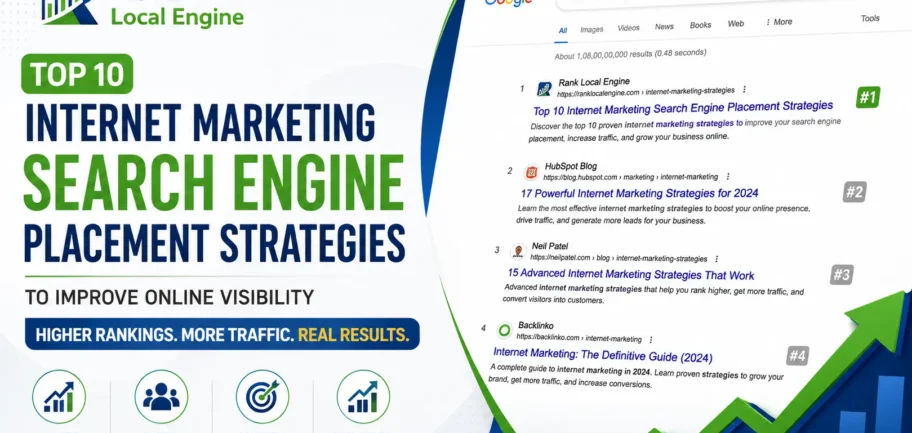
Getting your website to show up where people actually look is the whole point of internet marketing. You can have the best product or service in your industry, but if Google does not surface your pages on the first page of results, most potential customers will never find you.
Search engine placement refers to where your pages land in Google’s search results for specific keywords. Better placement means more clicks, more traffic, and more leads without paying for every single visitor. Search engine positioning is not a one-time project. It is an ongoing discipline that ties together content quality, technical health, authority, and user experience. The strategies below cover everything from technical fixes to content creation to local SEO, each one chosen because it drives real ranking outcomes.
Rank Local Engine (ranklocalengine.com) is one agency that puts these strategies into practice for small and medium businesses. Their approach combines local market knowledge with a full set of free SEO tools designed to help business owners audit and improve their own search engine placement.
Before we get into the individual strategies, here is a quick overview of where clicks actually go on a Google search results page, based on Backlinko’s analysis of millions of search results:
| Position | Average Click Share | Monthly Clicks (per 1,000 searches) |
| #1 | 27.6% | 276 |
| #2 | 15.8% | 158 |
| #3 | 11.0% | 110 |
| #4 | 8.0% | 80 |
| #5 | 7.2% | 72 |
| #6 | 5.1% | 51 |
| #7 | 4.0% | 40 |
| #8 | 3.2% | 32 |
| #9 | 2.8% | 28 |
| #10 | 2.5% | 25 |
| Beyond page 1 | <1% | <10 |
The difference between position 1 and position 10 is nearly 11x in traffic. Every position you gain compounds into more visitors, more leads, and more revenue. That is why improving online visibility through smart SEO strategies matters so much for businesses of any size. The strategies in this guide are designed to improve online visibility and drive measurable results from your search engine placement efforts.
1. Partner With a Results-Driven SEO Agency Like Rank Local Engine
The fastest path to better search engine placement is working with people who do this work every day and have the processes to back it up. Rank Local Engine is a Des Moines based SEO agency that focuses specifically on helping small and medium businesses improve their visibility on Google. They combine local market knowledge with proven technical SEO methods, and their approach is straightforward: audit what is broken, fix the foundations, build a content strategy around real customer searches, and track results monthly.
Why Local Agency Expertise Matters
What makes their approach different from most agencies is the specificity. Instead of sending clients a monthly report full of numbers that mean nothing, they focus on the metrics that actually matter: keyword rankings for terms your customers search, organic traffic growth, phone calls, and leads generated.
Their free SEO tools also let business owners check their own keyword density, internal linking, heading structure, and schema markup without paying for expensive software.
What You Get Compared to a Typical Agency
Here is a comparison of what working with Rank Local Engine looks like versus a typical agency:
| Feature | Typical Agency | Rank Local Engine |
| Report clarity | Wall of numbers, jargon-heavy | Plain English, actionable insights |
| Client focus | 200+ clients, junior staff managed | Small client roster, experienced team |
| Local market knowledge | National, one-size-fits-all | Des Moines market-specific strategy |
| Free tools included | Rarely | 26 free SEO tools |
| Pricing transparency | Hidden fees common | Clear pricing page |
| Google Business Profile optimization | Basic setup only | Full GBP audit and ongoing management |
If you are a local business in Des Moines or anywhere in Iowa, having an agency that understands your specific market, competition, and customer behavior gives you a real advantage. Learn more on their about us page.
2. Match Content to Search Intent
Google does not rank the page with the most keywords. It ranks the page that best satisfies what the searcher actually wants. Search intent is the reason behind a query, and getting it right is one of the highest-impact SEO strategies you can apply to your search engine positioning.
The Four Types of Search Intent
There are four main intent types, and each one requires a different content format to rank well:
| Intent Type | What the Searcher Wants | Example Query | Best Content Format |
| Informational | An answer or explanation | “how does local SEO work” | Guide, blog post, explainer |
| Commercial investigation | Comparing options before buying | “best SEO agencies in Des Moines” | Comparison table, review roundup |
| Transactional | Ready to take action | “hire SEO agency near me” | Service page with clear CTA |
| Navigational | Looking for a specific brand | “Rank Local Engine contact” | Clean, fast-loading brand page |
How to Identify Intent for Any Keyword
The practical move is simple: search your target keyword, look at what Google is currently rewarding, and match that format. If the top results are all long-form guides, your short product page will not compete. If the top results are comparison tables, write a comparison table.
You can compare intent across different keywords using Rank Local Engine’s Search Intent Comparison Tool to see which queries lean informational versus transactional.
Here is what the click distribution looks like by intent type:
| Intent Type | Average CTR for Position 1 | Average CTR for Position 5 | AI Overview Impact |
| Informational | 24.5% | 5.8% | High (48% of queries show AI Overview) |
| Commercial investigation | 31.2% | 8.4% | Moderate |
| Transactional | 35.8% | 10.1% | Low |
| Navigational | 42.1% | 3.2% | Very low |
Transactional queries have the highest click-through rates because searchers are ready to buy. Informational queries are most affected by AI Overviews because Google answers many of them directly on the results page.
For more detail on click-through rate optimization, check Rank Local Engine’s guide on improving click-through rate.
3. Build Topical Authority Through Content Clusters
Google rewards websites that demonstrate genuine depth on a specific topic rather than shallow coverage across many unrelated subjects. The way to build that authority is through content clusters, a structure where a comprehensive pillar page links to a group of supporting articles that cover subtopics in detail.
How Content Clusters Work
For example, a plumbing company might create a pillar page on “home plumbing maintenance” that links to separate articles on pipe insulation, water heater maintenance, leak detection, and drain cleaning. Each supporting article links back to the pillar, and Google recognizes the site as a genuinely authoritative resource on plumbing topics.
This approach works because Google evaluates topical relevance across your entire domain, not just individual pages. A site with 50 strong articles on a single topic will typically outrank a site with 500 articles spread across unrelated topics.
Use Rank Local Engine’s Keyword Grouping Tool to organize your keywords into logical topic clusters before you start writing.
Content Cluster Structure and Depth
Here is what a typical content cluster structure looks like for a local service business:
| Content Type | Target Keyword | Word Count | Internal Links |
| Pillar page | “home plumbing maintenance” | 2,500 – 3,500 | Links to 5-8 supporting articles |
| Supporting article | “how to insulate pipes before winter” | 1,200 – 1,800 | Links back to pillar + 1-2 related articles |
| Supporting article | “water heater maintenance tips” | 1,200 – 1,800 | Links back to pillar + 1-2 related articles |
| Supporting article | “signs of a hidden water leak” | 1,200 – 1,800 | Links back to pillar + 1-2 related articles |
| Supporting article | “how to unclog a drain properly” | 1,200 – 1,800 | Links back to pillar + 1-2 related articles |
First Page Sage’s algorithm analysis shows that niche expertise held steady at about 13% of algorithm weight in 2025. Building content clusters is the most reliable way to earn that weight.
Here is how content depth correlates with ranking positions:
| Content Depth | Average Ranking Position | Average Organic Traffic |
| Thin content (under 500 words) | 14.2 | 120 monthly visits |
| Standard content (500-1,500 words) | 9.8 | 450 monthly visits |
| Comprehensive content (1,500-3,000 words) | 5.4 | 1,200 monthly visits |
| Pillar-level content (3,000+ words) | 3.1 | 3,500+ monthly visits |
Before building your clusters, run Rank Local Engine’s Keyword Cannibalization Checker to make sure multiple pages on your site are not competing against each other for the same keyword.
4. Fix Technical SEO Issues That Quietly Kill Rankings
Technical SEO is the behind-the-scenes work that makes your website readable and accessible to search engines. Google sends automated bots to crawl your site, and if those bots hit broken links, slow load times, duplicate content, or broken redirects, your pages will not rank well regardless of how good your content is.
The Most Common Technical Problems
These are the technical issues we see most often when auditing websites for clients:
| Technical Issue | How It Hurts Rankings | How to Fix It |
| Slow page load times | 32% increase in bounce rate from 1s to 3s load time (Google) | Compress images, use CDN, minify CSS/JS |
| Broken links (404 errors) | Wastes crawl budget, signals neglect | Audit with tools, set up 301 redirects |
| Duplicate content | Splits authority between pages, confuses Google | Use canonical tags, consolidate pages |
| Missing canonical tags | Google may index wrong version of page | Add canonical tags to every page |
| No XML sitemap | Google may not discover all pages | Generate and submit sitemap |
| Redirect chains | Slows crawling, dilutes link equity | Fix to single-hop redirects |
| Mobile unfriendly design | Fails mobile-first indexing | Use responsive design |
| Missing schema markup | Misses rich result opportunities | Add structured data |
You can check for many of these issues using Rank Local Engine’s redirect checker and canonical tag checker. Running these checks takes minutes and can reveal problems that have been hurting your rankings for months.
Also check your robots.txt file to make sure you are not accidentally blocking important pages from being crawled.
Technical SEO Audit Checklist
Use this checklist to prioritize your technical fixes:
| Task | Priority | Expected Time | Impact |
| Fix crawl errors in Search Console | Critical | 1-2 hours | Immediate ranking improvement |
| Optimize Core Web Vitals (LCP, INP, CLS) | Critical | 2-4 weeks | Measurable visibility boost |
| Fix broken links and redirect chains | High | 2-3 hours | Preserves crawl budget |
| Add XML sitemap and submit to Google | High | 30 minutes | Ensures full indexation |
| Implement canonical tags | High | 1-2 hours | Prevents duplicate content issues |
| Add schema markup | Medium | 2-4 hours | Unlocks rich results |
| Fix mobile usability issues | Medium | 1-2 weeks | Required for mobile-first indexing |
| Optimize robots.txt | Medium | 30 minutes | Prevents accidental blocking |
For more on technical SEO, read Rank Local Engine’s guide on mobile-first indexing.
5. Optimize for Google’s Core Web Vitals
Core Web Vitals are three specific measurements that Google uses to evaluate user experience on your page. They are a confirmed ranking signal, and meeting the thresholds gives you a measurable advantage over the more than 50% of websites that still fail these assessments.
Understanding the Three Metrics
The three metrics you need to track and improve:
| Metric | What It Measures | Good Score | Poor Score | Your Target |
| Largest Contentful Paint (LCP) | Loading speed | Under 2.5s | Over 4.0s | Under 2.5 seconds |
| Interaction to Next Paint (INP) | Responsiveness | Under 200ms | Over 500ms | Under 200 milliseconds |
| Cumulative Layout Shift (CLS) | Visual stability | Under 0.1 | Over 0.25 | Under 0.1 |
Core Web Vitals do not override content relevance, but they function as tiebreakers between similarly qualified pages. When two pages are roughly equal in content quality and authority, the one with better performance metrics wins.
How Page Speed Affects Conversions
Here is the impact of page speed on conversion rates based on Google’s own research:
| Page Load Time | Bounce Rate Increase | Conversion Rate Impact |
| 1 second | Baseline | Baseline |
| 2 seconds | +103% | -7% |
| 3 seconds | +132% | -11% |
| 4 seconds | +150% | -17% |
| 5 seconds | +205% | -22% |
Practical improvements include compressing images and serving them in WebP format, eliminating render-blocking JavaScript, using a content delivery network (CDN), and fixing image dimensions to prevent layout shifts.
Prioritized Core Web Vitals Fixes
Start with the easiest fixes that have the highest impact:
| Fix | LCP Impact | INP Impact | CLS Impact | Difficulty |
| Compress and lazy-load images | High | None | None | Easy |
| Remove render-blocking CSS/JS | High | Medium | None | Medium |
| Use a CDN for static assets | High | None | None | Easy |
| Set explicit image dimensions | None | None | High | Easy |
| Minimize third-party scripts | Medium | High | Low | Medium |
| Use browser caching | Medium | Low | None | Easy |
| Optimize server response time | High | Medium | None | Hard |
Use Rank Local Engine’s Image Alt Text Generator to create descriptive, keyword-rich alt text for every image on your site. This improves both accessibility and your chances of ranking in Google Image Search.
6. Earn High-Quality Backlinks From Relevant Sites
Backlinks remain one of Google’s strongest trust signals. A link from another website to yours acts as a vote of confidence, telling Google that your content is worth referencing. But not all links are equal. One link from a topically relevant site with real organic traffic is worth more than fifty links from random directories.
Before pursuing new links, audit your existing backlink profile for toxic or spammy links that could be dragging your rankings down. Rank Local Engine’s Backlink Toxicity Checker can identify harmful links that need to be disavowed.
Backlink Quality Tiers
Backlinko’s analysis of 11.8 million Google search results found that the number 1 ranking page has an average of 3.8 times more backlinks than pages ranking positions 2 through 10. However, the tilt toward link quality over quantity has sharpened considerably.
Here is how link quality breaks down by tier:
| Link Tier | Description | Ranking Impact | Difficulty to Earn |
| Tier 1 | Editorial link from topically relevant site with 500+ monthly organic visitors | Highest | Hard |
| Tier 2 | Link from high-authority domain in adjacent niche, placed in content | High | Medium |
| Tier 3 | Link from relevant industry directory or resource page | Moderate | Easy |
| Tier 4 | Link from low-quality directory or comment section | Minimal to none | Very easy |
| Toxic | Link from spammy site, PBN, or paid link scheme | Negative (risk of penalty) | N/A |
Link Building Methods That Work in 2026
The most effective link-building methods right now:
| Method | Average Acceptance Rate | Link Quality | Time Investment |
| Original research and data | N/A (earned, not outreach) | Highest | High |
| Digital PR | 5-10% of pitches | Highest | High |
| Guest contributions | 10-20% of outreach | High | Medium |
| Broken link building | 15-25% reply rate | High | Medium |
| Partnerships and integrations | 40-60% acceptance | High | Low |
| HARO / journalist queries | 5-10% of responses | High | Medium |
Ahrefs’ 2025 ranking factors study found that pages in positions 1 through 3 had a median of 3.8 times more referring domains than pages in positions 7 through 10. Focus on earning links from sites within your vertical, not just any site with a high domain rating.
7. Build E-E-A-T Signals Across Your Content
E-E-A-T stands for Experience, Expertise, Authoritativeness, and Trust. It is not a direct ranking factor in the way that page speed is, but it shapes how Google’s quality rater systems evaluate your content. Pages that show genuine first-hand experience and clear author credentials tend to hold better positions, especially on topics that affect people’s health, finances, or safety.
How the March 2026 Update Changed Things
Google’s March 2026 update specifically targeted mass-produced AI content and rewarded pages that demonstrated original expertise. The data tells a clear story:
| Content Type | Visibility Change After March 2026 Update |
| Original data and research | +22% |
| First-hand expert content | +18% |
| Standard human-written content | +3% |
| AI-assisted with human editing | -12% |
| Mass-produced AI content | -71% |
Practical E-E-A-T Implementation
Practical ways to strengthen E-E-A-T across your website:
| Signal | How to Implement It | Impact Level |
| Author byline with real name | Add visible author name and bio to every article | High |
| Author credentials | Link to LinkedIn, professional profiles, or publications | High |
| First-hand experience references | Include specific examples from real projects | High |
| Specific data points | Add real numbers, dates, and measurable results | Medium |
| Cited sources | Link to primary sources by name | Medium |
| Schema markup for author | Use Author schema in structured data | Medium |
| Trust signals on site | Display certifications, awards, testimonials | Medium |
For local businesses, displaying NAP consistency across all directories and citations is a trust signal that Google uses to verify your business is legitimate. Add Article schema markup to your content so Google can clearly identify the author, date published, and content type.
8. Optimize Your Google Business Profile for Local Visibility
If your business serves customers in a specific geographic area, local SEO is non-negotiable. Your Google Business Profile is the single most important factor in whether you appear in the Google Maps section and the local pack, the map results that sit above regular search results and capture a significant portion of all local searches.
Why Local Search Matters for Your Business
More than 75% of local mobile searches result in a visit, call, or purchase within 24 hours. These are not casual browsers. They are people ready to buy right now. If your business is not showing up when those searches happen, a competitor is getting that customer.
Here is how Google determines which businesses appear in the local pack:
| Local Ranking Factor | Weight (Approximate) | What It Means |
| Google Business Profile relevance | 36% | How well your profile matches the search query |
| Distance from searcher | 26% | How close your business is to the person searching |
| Prominence (reviews, citations, links) | 23% | How well-known and trusted your business is |
| Website quality and relevance | 15% | How relevant your website content is to the query |
GBP Optimization Checklist
What a fully optimized Google Business Profile includes:
| GBP Element | Optimization Checklist | Common Mistake |
| Business categories | Primary + 4-9 secondary categories | Only selecting one category |
| Business description | 750 characters, keywords included naturally | Keyword stuffing or leaving blank |
| Photos | Minimum 10 high-quality photos, updated monthly | Using stock photos or no photos |
| Service area | Define all areas you serve | Leaving it blank |
| Posts | Weekly updates with offers or information | Never posting after initial setup |
| Reviews | Respond to every review within 24 hours | Ignoring negative reviews |
| Q&A | Pre-populate common questions | Letting others answer incorrectly |
Check your Google Business Profile setup using Rank Local Engine’s free GBP Analyzer to identify gaps that might be holding back your local rankings.
Time Investment for GBP Management
Here is what GBP optimization actually costs in terms of time:
| Task | Time Required | Frequency |
| Initial GBP audit and optimization | 4-6 hours | Once |
| Weekly posts | 30 minutes | Weekly |
| Review monitoring and responses | 20 minutes | Daily |
| Photo updates | 1 hour | Monthly |
| Q&A monitoring | 15 minutes | Weekly |
| Citation audit and cleanup | 2-3 hours | Quarterly |
| Full GBP review | 1-2 hours | Quarterly |
For a complete breakdown of local search factors, read Rank Local Engine’s guide on local SEO ranking factors in 2026.
9. Refresh and Update Existing Content
Content freshness jumped from less than 1% of algorithm weight to about 6%, making it the sixth most important ranking factor according to First Page Sage’s research. Web pages updated at least once per year gain an average of 4.6 positions compared to pages that have not been updated.
Why Refreshing Beats Creating New Content
Most businesses focus all their energy on publishing new content while ignoring the pages that already rank on page two. Those pages are your biggest opportunity. A page sitting at position 12 for a valuable keyword is already halfway to page one. Small, targeted improvements to that page can push it into the top five faster than creating an entirely new article.
Here is the ROI comparison between creating new content versus refreshing existing content:
| Action | Time Investment | Average Ranking Improvement | Traffic Impact |
| Create new article from scratch | 8-15 hours | 0-3 positions | Slow build over months |
| Refresh existing page-two content | 2-4 hours | 3-7 positions | Immediate gains within weeks |
| Optimize title tag + meta description | 30 minutes | 1-2 positions | 15-43% CTR improvement |
| Add internal links to existing page | 1 hour | 1-3 positions | 20-40% traffic increase |
| Update outdated statistics | 1 hour | 0-2 positions | Improved relevance signals |
What to Update and How Often
Here is what to update on your existing content:
| Update Type | Why It Matters | How Often |
| Replace outdated statistics | Google favors current, accurate information | Quarterly |
| Add new sections for recent developments | Shows topical freshness and depth | When industry changes occur |
| Improve internal linking | Passes authority from strong pages to target pages | Monthly |
| Refresh title tag and meta description | Improves click-through rate | Every 3-6 months |
| Add new images or visual content | Improves engagement signals | As needed |
| Update the publish date | Only after making meaningful changes | After real updates |
Use Rank Local Engine’s Internal Linking Suggestion Tool to find opportunities to link from your high-authority pages to the content you want to boost.
Scalify Labs’ research identifies refreshing old content before writing new content as one of the five highest-ROI SEO tactics. The highest-impact work is often sitting in your existing content library, not in creating something from scratch.
10. Track Rankings and Adjust Based on Data
Search engine placement is not something you fix once and forget. Rankings shift daily as competitors publish new content, Google rolls out algorithm updates, and search behavior changes. Systematic tracking turns raw ranking data into actionable decisions.
What to Track and Which Tools to Use
Tools like Google Search Console, Semrush, or Ahrefs let you monitor your positions for target keywords, track impressions and clicks, and identify which pages are gaining or losing ground. Look at average position and clicks together, not separately. A page can hold a strong position and still lose clicks if an AI Overview is answering the question directly on the results page.
Use Rank Local Engine’s SERP Preview Tool to see how your title and meta description appear in Google search results before publishing.
According to SparkToro’s analysis, zero-click searches accounted for nearly 65% of Google searches by late 2025. When an AI Overview dominates the top of the page, the only organic results consistently visible above the fold are positions 1 through 3. This makes those top spots significantly more valuable than they were even a year ago.
Monthly Tracking Dashboard
Here is what a practical monthly tracking dashboard should include:
| Metric | Tool | What to Look For |
| Keyword positions | Google Search Console | Trends over time, not daily fluctuations |
| Impressions | Google Search Console | Growing impressions = growing visibility |
| Clicks | Google Search Console | Actual traffic reaching your site |
| CTR (click-through rate) | Google Search Console | Low CTR at high position = fix your snippet |
| Organic sessions | Google Analytics | Overall traffic trends |
| Conversions from organic | Google Analytics | Is traffic turning into leads/sales |
| Core Web Vitals | PageSpeed Insights | Performance regressions |
| Backlink growth | Ahrefs or Semrush | New links earned vs. lost |
How to Interpret Your Data
Here is how to interpret your tracking data:
| Data Pattern | What It Means | What to Do |
| Position stable, clicks dropping | AI Overview eating your clicks | Restructure page to be quotable by AI |
| Position improving, impressions rising | SEO work is paying off | Keep doing what is working |
| High impressions, low CTR | Snippet is not compelling | Rewrite title tag and meta description |
| Position dropping across all keywords | Possible algorithm update or technical issue | Check Search Console for crawl errors |
| Traffic rising but conversions flat | Attracting wrong audience | Revisit keyword targeting and search intent |
| One page ranking for multiple keywords | Cannibalization risk | Consolidate or differentiate pages |
Review Cycle Schedule
Set up a regular review cycle to stay on top of your search engine positioning:
| Frequency | Tasks | Time Required |
| Weekly | Check for sudden ranking drops, review Search Console errors | 15 minutes |
| Monthly | Review keyword positions, traffic trends, lead metrics | 1-2 hours |
| Quarterly | Audit content freshness, refresh top pages, reassess keyword targets | 4-6 hours |
| After algorithm updates | Analyze what changed, compare before/after, adjust strategy | 2-4 hours |
Watch These Videos for a Deeper Understanding
If you want to see these strategies explained visually, these two YouTube videos cover the most important concepts from this article. Both are from Ahrefs, one of the most trusted names in SEO research, and they explain the current state of search in plain language.
Video 1: SEO in 2026: How I’d Rank in Google in the AI Era
Channel: Ahrefs | Published: March 2026 | Length: ~20 minutes
This video explains how SEO has changed with the rise of AI Overviews, why brand mentions now matter more than backlinks, and how to identify which keywords still drive organic clicks. It covers the three key shifts in search behavior: the move from keyword targeting to entity-based SEO, being mentioned across multiple authoritative sources, and why action-oriented queries still pull strong click-through rates. The video includes real data from Ahrefs’ own research on 50,000 websites and shows exactly how to reverse-engineer what AI assistants are citing in your niche.
This video walks through a practical five-step process for making your brand visible in AI search results, including Google AI Overviews, ChatGPT, and Perplexity. It covers how to increase brand mentions across the web, create content that AI systems love to cite, structure your content for AI comprehension, and dominate Reddit and YouTube for maximum AI reach. The video includes a walkthrough of Ahrefs’ Brand Radar tool and shows how to find the exact pages that get cited in AI answers for your niche.
Limitations
No strategy works instantly. SEO is a long-term investment, and most businesses start seeing meaningful movement in three to six months. Some tactics, like fixing technical issues or optimizing title tags, can produce quick wins within weeks. Others, like building topical authority and earning backlinks, compound over time. The businesses that stick with it past the six-month mark are the ones that end up with a genuinely strong online presence that keeps bringing in leads month after month.
It is also worth noting that not every strategy works equally well for every business. A local plumber has different priorities than an e-commerce store selling nationally. The strategies above are broadly applicable, but the specific emphasis should shift based on your industry, competition level, and customer behavior.
You can explore Rank Local Engine’s case studies to see how different businesses have applied these strategies with measurable results. For a complete SEO education, visit their SEO Mastery Hub.
FAQ
How long does it take to see results from search engine placement strategies?
Most businesses see meaningful improvements within three to six months of consistent effort. Quick technical fixes can produce quick wins in weeks, especially for pages already ranking on page two. Building topical authority and earning backlinks takes longer, typically four to eight months before full impact is visible.
What is the difference between SEO and search engine placement?
SEO is the broader discipline covering everything from site architecture to content strategy to link building. Search engine placement focuses on improving the specific ranking position of individual pages for target keywords. Placement is a subset of SEO, the work that actually moves a URL higher on the results page.
Can I improve my search engine placement without hiring an agency?
Yes, many of the strategies described here can be implemented independently, especially technical fixes, on-page optimization, and content updates. The learning curve is steep, and mistakes can cost months of lost progress. Working with an experienced agency like Rank Local Engine accelerates results because they have already solved the problems you are about to encounter.
How does AI affect search engine placement in 2026?
AI Overviews now appear on roughly 48% of all search queries. When they show up, the top result loses about 58% of its clicks. This means being in the top three organic positions, or being cited directly within the AI Overview, matters more than ever. Content that answers questions directly and demonstrates genuine expertise has the best chance of earning those citations.
What role do backlinks play in search engine placement?
Backlinks remain one of Google’s strongest trust signals, though their relative weight has shifted. Quality matters far more than quantity. A single link from a topically relevant site with real organic traffic can move a page more than dozens of links from low-quality directories. Focus on earning editorial links through genuinely useful content, original research, and industry relationships.